
High-precision machinery engineered for European standards, delivering superior metallurgy, exact feed reproducibility, and seamless robotic/orbital integration.
An engineering analysis of how micro-stepper cold wire feeding eliminates operator variance, reduces heat-affected zone (HAZ) cracking, and boosts deposition rates in critical alloy fabrications.
Manual TIG welding introduces natural physical fatigue, resulting in non-uniform filler wire dipping frequency. Our advanced China wholesale cold wire feeders for TIG welding utilize a dual-channel micro-stepper motor driven by microprocessor-controlled digital algorithms. By synchronizing the wire retraction and pulsing mechanism directly with the primary arc power source current pulses (peak and background current phases), filler wire is fed precisely into the molten pool at the exact moment of peak energy. This prevents arc instability, reduces tungsten contamination, and delivers a consistent, ripple-free bead profile compliant with stringent European radiographical standards.
When fabricating high-grade alloys such as Super Duplex (2507), Inconel 625, or 316L stainless steel, uncontrolled thermal input degrades corrosion resistance and causes intergranular cracking. Continuous manual wire feeding often requires higher arc current to melt filler, increasing the overall Heat-Affected Zone (HAZ). A automated cold wire feeder acts as a physical heat sink. As cold wire is continuously driven into the weld pool at controlled velocities (0 to 500 cm/min), it absorbs latent heat during fusion. This enables higher deposition rates without exceeding maximum allowable interpass temperatures—a critical metric required by Danish engineering procurement contracts.
Evaluating cold wire TIG automation against traditional manual GTAW and high-deposition GMAW pulse systems for Danish precision fabricators.
| Performance Parameter | Manual GTAW (TIG) | China Wholesale TIG Cold Wire Feeder | Pulsed GMAW (MIG/MAG) | Hot Wire GTAW System |
|---|---|---|---|---|
| Deposition Rate (kg/hr) | 0.4 – 0.8 kg/hr | 1.5 – 2.8 kg/hr | 3.0 – 5.5 kg/hr | 2.5 – 4.5 kg/hr |
| Heat Input Control | Moderate (Operator Dependent) | Excellent (Precise Microcontroller) | High (Risk of distortion) | Low-Moderate |
| Weld Defect / X-Ray Pass Rate | 88% - 94% | 99.2% - 99.8% | 92% - 95% | 98.5% |
| Operator Skill Dependency | Extremely High | Low (Semi-Automated Operation) | Moderate | High |
| Capital Investment (ROI) | Low initial / High labor cost | Optimal (Fast payback in <6 mos) | Moderate | Extremely High |
| Standard Compliance | ISO 5817 Class B | ISO 5817 Class B/B+ (EN 1090) | ISO 5817 Class C/B | ISO 5817 Class B |
How direct factory sourcing of Chinese cold wire feed automation empowers Danish manufacturing hubs from Esbjerg to Copenhagen.
Denmark leads the global energy transition, centered around offshore turbine manufacturing and marine foundation fabrication in Esbjerg and Aalborg. Structural steel jackets, monopile secondary structures, and internal platform pipework demand continuous, zero-defect welds. Operating in high-humidity, marine environments requires four-roll drive cold wire feeder units equipped with IP23 enclosures. By pairing wire feeders with column-and-boom manipulators or orbital tracks, Danish shipyards achieve flawless root-to-cap penetration on heavy-wall C-Mn and low-alloy steel pipes without micro-porosity.
Home to global pharmaceutical giants (such as Novo Nordisk supply chains) and dairy process engineering clusters in Aarhus, Denmark maintains strict hygienic manufacturing mandates. High-purity process piping (ASME BPE standard) requires ultraclean internal weld beads with zero oxidation and internal roughness (Ra) below 0.4 µm. Utilizing specialized Chinese cold wire feeders with automatic argon back-purge control and pulse delay feeding guarantees consistent internal penetration without sagging or sugar formation on 316L and Hastelloy tubing.
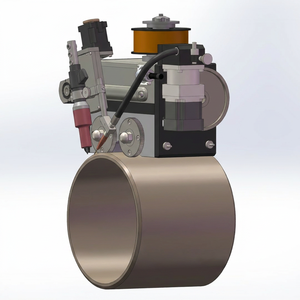
Danish municipal district heating networks (Fjernvarme) rely on miles of underground pre-insulated steel pipelines engineered for 50+ year operational lifespans under EN 13941 standards. Field welding in narrow trench conditions requires compact, lightweight, OD-mounted cold wire feeding heads. Our portable cold wire feed systems feature quick-release spools and high-torque stepper motors capable of pushing wire through 5-meter flexible conduit liners, enabling welders to execute 100% radiographically sound circumferential joints efficiently.
Navigating EU directives, labor market dynamics, and technological shifts driving automation adoption in the Nordic region.
Denmark, like much of Northern Europe, faces a structural shortage of certified International Welding Specialists (IWS) and manual GTAW craftsmen. As veteran welders retire, Danish metalworking firms face rising hourly labor costs and strict workplace safety (Arbejdstilsynet) regulations. Integrating China factory TIG cold wire feeders enables fabricators to transition from manual GTAW to mechanized operations. A semi-skilled operator can oversee automated wire-fed TIG cells, doubling output while lowering physical strain and reducing exposure to welding fumes.
Danish structural steel manufacturers operating under EN 1090-2 (Execution Classes EXC3 and EXC4) must prove that all welding processes adhere to qualified Welding Procedure Specifications (WPS). Our factory-direct cold wire feeders feature digital LED displays showing real-time wire feed speed (m/min), pulse frequency (Hz), and delay parameters. This transparent telemetry allows Danish Quality Assurance (QA) managers to record and verify parameter stability, directly supporting ISO 3834-2 comprehensive quality compliance requirements.
Combining advanced Chinese R&D, certified quality control, and seamless OEM integration for global equipment distributors and engineering firms.
Our state-of-the-art manufacturing campus features ISO 9001:2015 quality management systems, dedicated SMT board assembly lines, and high-load burn-in testing bays. Every cold wire feeder engineered for the Danish market carries full CE marking (EMC Directive 2014/30/EU and Low Voltage Directive 2014/35/EU), guaranteeing safe, noise-free integration alongside high-frequency (HF) TIG arc ignition systems.
Designed for global versatility, our wire feeders accept universal single-phase input voltage (AC 110V/220V, 50/60 Hz), perfectly matching Denmark’s grid power standard (230V / 50 Hz). The system provides multi-brand signal interface ports (analog 0-10V, RS485 Modbus, dry contact relay switches) allowing plug-and-play installation with Fronius, ESAB, Miller, Kemppi, and Chinese inverter power sources alike.
We provide full-service export support tailored for Danish buyers, offering flexible Incoterms including FOB, CIF Copenhagen/Aarhus, and DDP (Delivered Duty Paid). Goods are packed in export-grade, moisture-proof, shock-absorbing wooden crates. Furthermore, we maintain a comprehensive stock of critical spare parts—including feed rollers, wire conduits, tungsten alignment tips, and control PCBA cards—for immediate express air shipment.
Answers to common technical, logistics, and compliance questions raised by Danish welding engineers and procurement managers.
Partner directly with China’s premier wholesale cold wire feeder manufacturer. Contact our application engineering team for factory pricing, customized OEM integrations, and complete technical specifications.