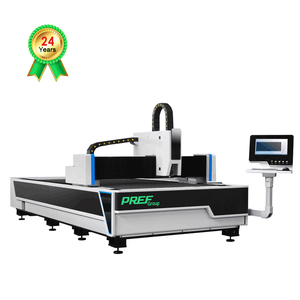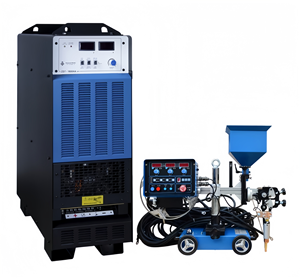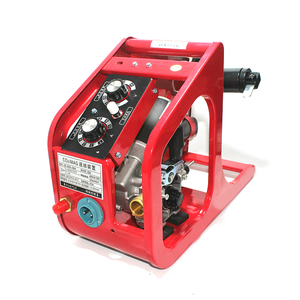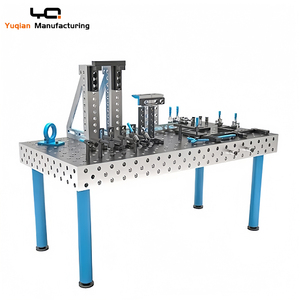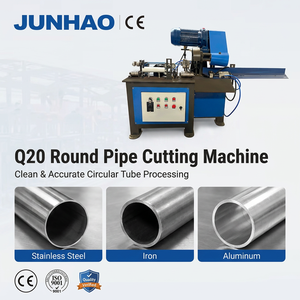
Explore our engineered equipment catalog, from medium-frequency spot welding technology to heavy-duty automated cutting platforms and 3D positioning fixtures.
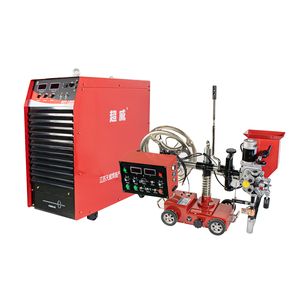
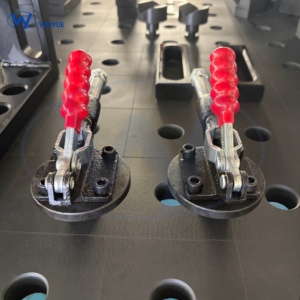
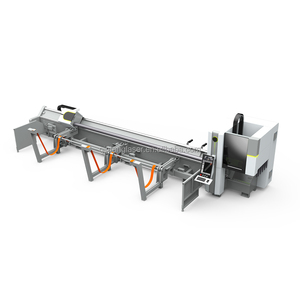
An authoritative technical analysis of Inverter Power Sources, Nugget Formation Thermodynamics, and Closed-Loop Control Systems in Modern Industrial Manufacturing.
In high-throughput industrial manufacturing, Resistance Spot Welding (RSW) remains the foundational metal joining methodology for structural sheet metal, automotive bodies, battery pack arrays, aerospace sub-assemblies, and heavy HVAC equipment. As global manufacturing transitions toward lightweight Advanced High-Strength Steels (AHSS), Ultra-High-Strength Steels (UHSS), and aluminum alloys, traditional 50Hz/60Hz AC transformer-based spot welders are rapidly being superseded by Medium-Frequency Direct Current (MFDC) Inverter Spot Welding Systems.
As a leading spot welding machine manufacturer and supplier, our engineering philosophy is rooted in controlling the fundamental physics of Joule Heating ($Q = I^2 R t$). Achieving structural integrity without surface degradation, expulsion, or micro-cracking requires millisecond-level current control and synchronized electrode force profiles.
Legacy single-phase AC spot welders introduce current zero-crossing pauses 100 to 120 times per second. During these zero-crossings, the weld pool experiences thermal dissipation into the copper electrodes, leading to inconsistent nugget growth and higher peak current requirements. In contrast, 1000Hz–4000Hz MFDC inverter technology rectifies the three-phase AC input into a continuous, ripple-free DC welding current.
| Technical Parameter | Traditional 50/60Hz AC Spot Welder | Advanced MFDC Inverter Spot Welder | Operational Gain / Advantage |
|---|---|---|---|
| Current Output Profile | Sine Wave with Zero-Crossings | Continuous, Ripple-Free DC Current | Faster Energy Transfer |
| Response Time / Control Resolution | 10 ms to 20 ms Control Cycle | 1.0 ms to 0.25 ms Closed-Loop Feedback | Zero Thermal Expulsion |
| Power Factor ($\cos \phi$) | 0.40 – 0.60 (High Reactive Power) | 0.90 – 0.98 (Balanced Three-Phase Load) | 35% Lower KVA Demand |
| Electrode Wear Rate | High (Thermal Spikes & Mechanical Shock) | Low (Uniform Heat & Controlled Force) | 3x-5x Extended Tip Life |
| Non-Ferrous & UHSS Capability | Poor / Inconsistent Nugget Quality | Exceptional (Aluminum, Galvanized, DP1000) | Broad Metallurgical Range |
A critical limitation of low-cost spot welding equipment is reliance on constant current control (CCC). In real-world factory environments, sheet metal fit-up gaps, surface oxidation, oil residues, and electrode tip wear introduce dynamic resistance variations. Modern industrial spot welders utilize Adaptive Resistance Control. By measuring secondary voltage across the electrode tips and secondary current every 100 microseconds, the inverter controller calculates the instantaneous dynamic resistance curve and automatically adjusts the current output in real-time to guarantee target nugget size regardless of surface contamination or fit-up anomalies.
Eliminating middlemen, traders, and re-labelers. We design, build, test, and service the entire resistance welding chain in-house under strict ISO 9001:2015 certified quality management systems.
Unlike suppliers who source generic white-label power boards, our internal R&D engineering team designs every IGBT gate driver, microcontroller logic board, and high-frequency transformer. This ensures total control over arc timing, fault protection, and long-term component availability.
Electrode deflection during clamping causes asymmetrical nugget formation and excessive edge expulsion. Our spot welder frames are constructed from high-tensile normalized steel structures subjected to finite element analysis (FEA) to eliminate arm flexing under high pneumatic or servo forces.
We rate all industrial spot welders and multiprocess power sources under strict international standards: tested continuously at 40°C ambient temperature over a 10-minute cycle. When we rate a machine for 60% or 100% duty cycle, it delivers uninterrupted factory output without thermal shutdowns.
Our spot welding machines and automated cells feature native IoT telemetry options. Track secondary current, voltage curves, squeeze time, weld time, pressure levels, and total spot counts in real-time across your global manufacturing facilities for complete quality traceability.
High-frequency spot welding generates intense localized heat at the SCR switches, inverter modules, secondary transformers, and electrode tips. Our closed-loop internal water channels safeguard critical copper components, maintaining peak conductivity and preventing thermal fatigue.
With over 22,600 machines operating in global markets, we maintain an extensive inventory of standardized consumable tips, arms, pneumatic cylinders, SCR blocks, and controller boards, paired with rapid-response application engineers.
Key technological shifts reshaping B2B procurement decisions for automotive OEMs, battery module assemblers, and structural metal fabricators worldwide.
Traditional spot welders rely on pneumatic air cylinders to drive the upper electrode. While robust, pneumatic systems lack precise velocity and force control, leading to high electrode impact velocity, tip mushrooming, severe surface indentations, and mechanical noise. The market is shifting rapidly toward Servo-Electric Actuation. Integrated servo drives allow soft-touch workpiece contact, pre-programmable force profiles during the squeeze-weld-hold cycle, and instant tip stroke adaptation for multi-layer sheet stack-ups.
The rapid expansion of the Electric Vehicle (EV) industry requires joining copper to aluminum, nickel-plated steel to copper, and multi-layer foil tab stacks. Conventional resistance spot welding fails on these materials due to high thermal conductivity and low electrical resistance. Procurement teams are specifying High-Frequency Inverter Spot Welders (up to 4kHz) and Ultrasonic Metal Welders with specialized capacitive discharge capabilities to deliver micro-joule precision without damaging sensitive lithium-ion cell chemistry.
Destructive tear-down testing (chisel and peel tests) is expensive and slow. Modern spot welding cells incorporate sensor fusion—combining acoustic emission sensors, optical displacement sensors, displacement monitoring, and dynamic resistance signatures. Machine learning models run at the edge controller to evaluate 100% of weld spots in real-time, assigning a quality probability score to every single weld nugget before the component leaves the fixture.
Industrial power grids are enforcing strict peak power penalties and power factor requirements. Inverter-based MFDC spot welding technology reduces energy consumption by up to 40% compared to legacy line-frequency transformers. Furthermore, because energy is drawn equally across all three line phases, factory electrical infrastructure can be sized significantly smaller, lowering initial capital expenditure on sub-stations and copper cabling.
Match your production metal, thickness range, and throughput target with the ideal machine configuration.
| Application / Material | Material Thickness Range | Recommended Power Technology | Electrode Clamping Type | Key Selection Criteria |
|---|---|---|---|---|
| Mild Steel & Low Carbon Structural | 0.5 mm + 0.5 mm to 3.0 mm + 3.0 mm | AC Single Phase or MFDC Inverter (25kVA – 100kVA) | Pneumatic Cylinder (3.0 kN – 6.0 kN) | Cost efficiency, simple maintenance, rugged frame rigidity. |
| Galvanized Sheet & High Strength Steel | 0.8 mm + 0.8 mm to 2.5 mm + 2.5 mm | MFDC Inverter 1000Hz (60kVA – 150kVA) | High-Speed Pneumatic or Servo Drive | Adaptive resistance control to prevent zinc layer vaporization expulsion. |
| Aluminum Alloys (5050 / 6061 Series) | 1.0 mm + 1.0 mm to 2.0 mm + 2.0 mm | High-Current MFDC / Capacitor Discharge (150kVA+) | Servo-Electric Actuation (Fast Follow-Up) | Extremely high peak current capability, rapid electrode force response. |
| Precision Electronics / Battery Tabs | 0.05 mm + 0.05 mm to 0.5 mm + 0.5 mm | Micro-Inverter / Transistor Spot Welder (1kHz – 4kHz) | Precision Micro Pneumatic / Electromagnetic | Millisecond energy delivery, displacement monitoring, zero thermal bleed. |
| Heavy Wire Mesh & Cross-Wire Joining | 2.0 mm to 12.0 mm Wire Diameter | Multi-Gun AC or MFDC Projection Spot Welder | Heavy-Duty Dual-Force Air Cylinders | High platen flatness, synchronized multi-spot transformer arrangement. |
Expert responses to critical engineering, installation, and operational questions asked by plant managers and procurement professionals.
kVA (Kilovolt-Amperes) represents the thermal power capacity rating of the welding transformer under a specified duty cycle (typically 50%). Secondary Welding Current (measured in Amperes or kA) is the actual electrical current delivered at the electrode tips during the weld cycle to form the molten nugget.
When selecting a spot welder, focusing solely on kVA can be misleading because secondary loop impedance, throat depth, throat height, and inverter efficiency dictate how much of that kVA is converted into secondary current. For example, a 50kVA MFDC inverter welder can often deliver higher usable secondary current than an 80kVA legacy AC welder due to superior power factor and direct current rectification.
The throat depth is the distance from the centerline of the electrodes to the front face of the machine frame, while the throat height is the vertical clearance between the upper and lower horn arms.
Increasing the throat depth or height enlarges the secondary inductive loop of the machine. In traditional AC spot welders, larger throat dimensions drastically increase inductive reactance, causing severe voltage drops and requiring larger transformers. In MFDC spot welders, because the secondary output is rectified direct current (DC), inductive reactance losses are eliminated, allowing for deep throat configurations without significant current degradation.
Electrode material selection directly governs tip lifespan and weld nugget quality:
Industrial spot welders require a continuous supply of clean, cool water to prevent thermal breakdown of internal components. Recommended cooling parameters include:
A complete spot welding cycle consists of four distinct timing phases: Squeeze Time, Weld Time, Hold Time, and Off Time.
Squeeze Time allows the pneumatic or servo cylinder to build full electrode force before current fires. If current fires before full pressure is established, severe violent expulsion (sparking) occurs, damaging tip faces and destroying metal structure. Hold Time maintains mechanical clamping pressure after current ceases, allowing the molten weld nugget to solidify under compression without internal shrinkage porosity or cooling cracks.
Overseas buyers should request official test documentation validating machine performance according to IEC 60974-1 or ISO 5826 standards. Ensure the manufacturer specifies the ambient testing temperature (typically 40°C) and the test interval period (10 minutes).
A machine rated at 500A @ 60% duty cycle under 40°C can run continuously for 6 minutes out of every 10 minutes at 500 Amperes. Be cautious of low-cost manufacturers rating machines at 20°C ambient temperatures or using short 5-minute test cycles, which artificially inflates output figures.
We provide full lifecycle support for all international and domestic orders. This includes comprehensive electrical schematics, mechanical drawings, operator training manuals, and remote video commissioning support with our application engineers.
Additionally, we maintain standardized spare parts packages (electrode holders, replacement tips, SCR thyristor modules, pneumatic seals, and logic boards) ready for immediate global dispatch to guarantee zero unplanned downtime in your facility.
Consult with our senior welding engineers to calculate required kVA capacity, simulate joint resistance curves, or request custom automation cell proposals.
Send an Inquiry