
In modern heavy metal fabrication, structural welding, pressure vessel manufacturing, and robotic automation cells, positioning accuracy directly impacts deposition rates, weld seam integrity, operator safety, and cycle times. Transitioning from out-of-position manual welding to ergonomically positioned flat or down-hand welding typically yields a 35% to 60% increase in arc-on time while drastically reducing joint defects and post-weld grinding.
Selecting a top-tier welding positioner table manufacturer requires evaluating structural rigidity, mechanical backlash tolerances, grounding current capacities, and surface hardness treatment. Advanced Power Sources Limited (APS Welding) brings over two decades of integrated engineering—combining IGBT power sources with precision-machined 3D modular tables and automated rotary turners engineered to withstand high-duty industrial cycles under ISO 9001:2015 standards.
Explore our top industrial recommendations engineered for light assembly, medium hardware, heavy pipe spools, and high-volume 3D modular clamping.
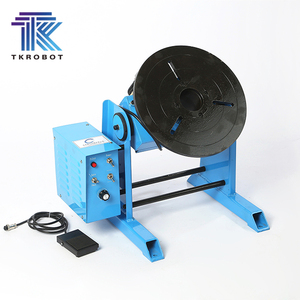
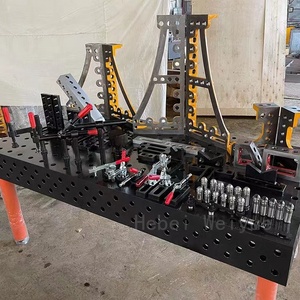
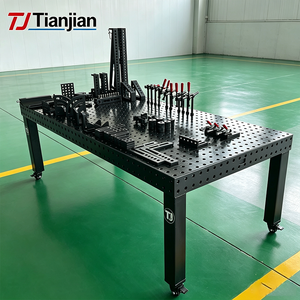
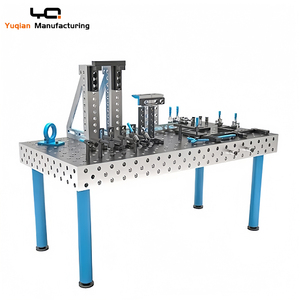
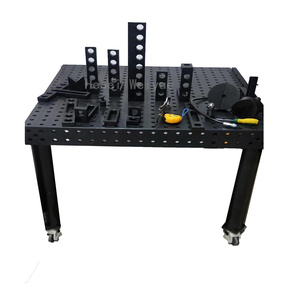
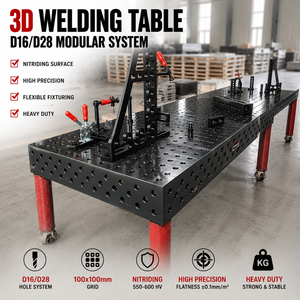
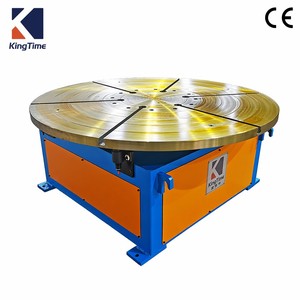
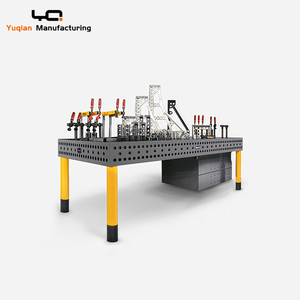
Procuring an industrial welding positioner or 3D clamping table demands rigorous mechanical calculation. Choosing equipment based solely on raw weight payload often leads to premature gearbox failure, rotational instability, or welding arc blow.
Payload capacity is inversely proportional to the distance from the table surface to the workpiece CG (Center of Gravity) and its offset from the rotational axis. Always verify the manufacturer's torque rating curve (Nm) rather than gross weight limits alone.
D16 Systems (16mm hole diameter on 50mm grid) are designed for light-to-medium sheet metal and precision frames up to 2,000 kg. D28 Systems (28mm hole diameter on 100mm grid) provide the heavy-duty shear resistance needed for heavy structural beams and thick plate fabrications.
Untreated cast iron or soft carbon steel tables suffer from severe weld spatter adhesion, surface scratching, and corrosion. Plasma Nitriding treatment creates a hard protective layer (HV750+) that repels slag, prevents rust, and extends fixture life by 5x.
| Technical Parameter | 3D Modular Tables (D16 / D28) | 1-Axis Rotary Table Positioners | 2-Axis Tilt-Rotate Positioners |
|---|---|---|---|
| Primary Mechanism | Static 5-Face Grid Platform with Clamping Tools | Continuous Motorized Horizontal Rotation | Motorized Table Rotation + Hydraulic/Gear Tilt |
| Payload Range | Up to 10,000 kg (Distributed Static) | 10 kg to 5,000 kg Rotational | 100 kg to 10,000+ kg Dynamic |
| Best Application | Complex 3D Frames, Tubular Steel, Machine Chassis | Flange-to-Pipe, Cylindrical Shells, Small Fittings | Pressure Vessel Heads, Valve Bodies, Complex Drums |
| Weld Position Capability | Manual fixture positioning required | 360° Continuous Flat Seam Rotation | Full 360° Rotation + 135° Downhand Tilting |
| Automation Readiness | Ideal for Manual Tacking & Cobot Cells | Integrated VFD for Automatic MIG/TIG/SAW | Full CNC / EtherCAT Servo Synchronized Integration |
As smart factories transition toward lean manufacturing and robotic collaboration, welding positioning equipment is evolving from static workbenches into fully synchronized, data-connected automation nodes.
Modern rotary positioners now incorporate zero-backlash planetary gearboxes driven by AC servomotors. This allows the positioner's rotation to act as the 7th or 8th external axis of a welding robot or cobot, enabling continuous interpolation during arc motion.
Equipment integrated with IoT systems (like APS WeldVisor) allows shop floor supervisors to track exact arc-on time, table speed consistency, operational duty cycles, and real-time grounding resistance to prevent weld defects and track productivity KPIs.
Untreated tables are rapidly being phased out. Enterprise procurement guidelines now mandate thermochemical surface treatments (Plasma Nitriding + Black Oxidation) to prevent spatter adhesion without relying on anti-spatter chemical sprays that pollute the shop floor.
When sourcing industrial positioning machinery and power equipment, working directly with an ISO 9001:2015 certified original equipment manufacturer eliminates middleman markups and guarantees dedicated technical support.
From circuit board design for digital positioner controllers to heavy mechanical machining at our Old GIDC Gundlav, Gujarat facility, every component is manufactured, assembled, and load-tested under strict quality control.
We supply the entire welding setup—IGBT Inverter MIG/TIG/SAW power sources, motorized rotators, 3D modular clamping platforms, column and booms, and CNC gantry cutters—ensuring 100% hardware compatibility.
Over 22,600 machines deployed across shipbuilding, heavy structural engineering, thermal power plant fabrication, pressure vessel manufacturing, and international cross-country pipeline projects.
Direct access to trained service engineers, fast spare parts delivery, custom application engineering consultation, and lifetime technical support for export clients worldwide.
Get expert answers to common engineering, selection, and purchasing questions regarding welding positioners and 3D tables.
Required rotation torque is calculated by multiplying the workpiece weight (N) by the eccentricity distance (m) between the Center of Gravity (CG) and the center of the rotation shaft. Tilting torque requires multiplying the total weight by the distance from the table surface to the CG plus safety margins (typically 20-30%). Always consult the manufacturer's load-offset diagram before specifying gear ratios.
D16 systems utilize 16mm boreholes arranged on a 50mm x 50mm grid, making them ideal for light-to-medium sheet metal, tubing, and component assembly with table load ratings up to 2,500 kg. D28 systems feature 28mm boreholes on a 100mm x 100mm grid, built for heavy structural steel, thick plate, and large weldments supporting static loads over 10,000 kg.
Plasma nitriding infuses nitrogen atoms deep into the metal surface, raising surface hardness up to HV750+ (approx. 55-62 HRC). This process renders the surface extremely resistant to weld spatter adhesion, scratches, and corrosion. Spatter easily wipes off without needing anti-spatter sprays or aggressive grinding, maintaining sub-millimeter grid accuracy for decades.
High-quality welding positioners use heavy-duty copper-graphite grounding brushes held under constant spring pressure against a machined brass ring on the main shaft. This ensures continuous, low-resistance electrical contact (up to 1000A+) directly to the workpiece, protecting internal bearings and gearboxes from electrical arcing and pitting.
Yes. All APS motorized positioners come equipped with variable frequency drives (VFD) or digital controllers featuring interface terminals for arc-start signals, rotation delay, emergency stop interlocks, and speed feedback. They pair seamlessly with APS Endeavour SAW power sources or multiprocess MIG machines for automated circumferential seam welding.
APS manufactures positioning machines and power equipment configured for global power grids, supporting 380V, 400V, 415V, or 480V 3-phase supply at both 50Hz and 60Hz. Input power specs can be customized based on your facility's local grid standards prior to shipment.
Send your workpiece dimensions, CAD drawings, base materials, and target production volume to our application engineering team. We will help you select the exact 3D clamping grid or rotary positioner class for your shop.