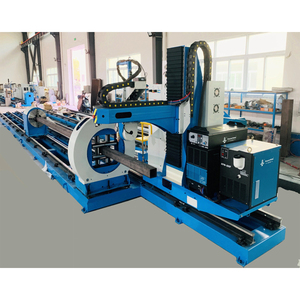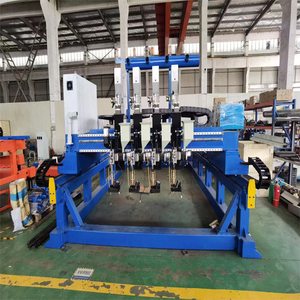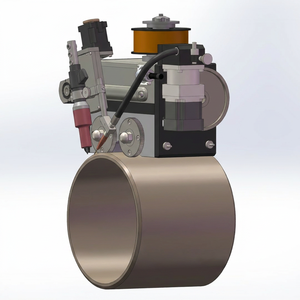
Engineered for seamless integration into heavy pressure vessel, offshore piping, energy sector, and structural steel fabrication workflows.
Combining proprietary IGBT inverter electronics, multi-axis automated motion controls, and heavy-duty structural design for uncompromised weld integrity.
Unlike trading companies or white-label assemblers, we design, program, and build every IGBT inverter control board and motion controller in-house. This guarantees deep application engineering support and immediate troubleshooting without third-party escalation delays.
Our manufacturing lifecycle adheres to stringent quality controls. Every custom OEM pipe flange welder undergoes 100% duty cycle load testing at elevated ambient temperatures (40°C) prior to export dispatch, ensuring compliance with ASME IX, AWS D10.11, and EN ISO 15614 standards.
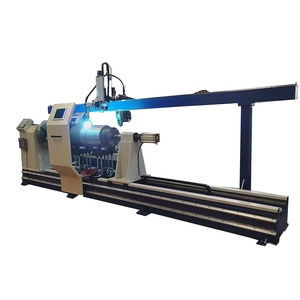
We deliver completely unified pipe welding workcells—integrating heavy-duty welding positioners, self-aligning rotators, cold wire feeders, AVC (Automatic Voltage Control) torches, and WeldVisor Industry 4.0 telemetry systems under a single operational architecture.
In high-pressure piping systems, offshore jacket structures, nuclear cooling loops, and petrochemical refineries, the structural integrity of pipe-to-flange circumferential joints is paramount. Manual welding of slip-on flanges, weld neck flanges, and socket flanges introduces variability in heat input, arc length, and bead profile—often leading to volumetric defects such as lack of side-wall fusion, porosity, and inter-pass cold laps. Custom OEM Pipe Flange Welders engineered by Advanced Power Sources Limited solve these challenges by digitizing precision motion and arc characteristics.
An automated pipe flange welder coordinates rotational axis motion (via headstock positioners or rotators) with multi-axis torch manipulators. By utilizing digital Closed-Loop Hall Effect sensing and proprietary IGBT inverter power sources, our systems maintain constant deposition rates, exact inter-pass temperature management, and continuous arc length calibration. Whether utilizing Gas Metal Arc Welding (GMAW/MIG), Gas Tungsten Arc Welding (GTAW/TIG), Submerged Arc Welding (SAW), or Laser-Arc Hybrid processes, automated flange welders ensure 100% Radiographic Testing (RT) and Ultrasonic Testing (UT) pass rates across carbon steel, duplex stainless, and high-nickel alloy piping.
Information Gain Engineering Note: When welding high-alloy pipe flanges (e.g., Inconel 625 cladding or Duplex 2205), precise heat input control ($kJ/mm$) is critical to prevent ferrite-austenite phase imbalance or toxic intermetallic phase precipitation (such as Sigma phase). Our pulse-curve micro-controllers restrict peak current duration, stabilizing the molten pool while preventing thermal distortion of flange sealing faces.
Industrial piping spools utilize diverse flange geometries, each presenting distinct joint preparation and torch accessibility requirements. Custom OEM customization ensures that clamping fixtures, pneumatic purging mandrels, and weaving torches adapt seamlessly to specific spool designs:
To quantify the ROI of adopting specialized automated flange welding machinery, consider the performance matrix compiled from operational data across global oil & gas piping fabrication yards:
| Performance Parameter | Manual SMAW / GTAW | Semi-Auto GMAW (Handheld) | Automated Dual-Torch SAW Workstation | 8-Axis CNC Robotic Flange Welder |
|---|---|---|---|---|
| Deposition Rate (kg/hr) | 0.8 – 1.5 kg/hr | 2.0 – 3.5 kg/hr | 6.5 – 12.0 kg/hr | 4.5 – 8.0 kg/hr |
| Arc-On Time Efficiency | 20% – 30% | 35% – 45% | 75% – 85% | 85% – 92% |
| Defect Rate (UT/RT Rejections) | 5.0% – 8.0% | 3.0% – 5.0% | < 0.5% | < 0.1% |
| Flange Face Heat Distortion | High (Requires Re-facing) | Moderate | Low (Controlled Interpass) | Minimal (Precision Thermal Input) |
| Operator Skill Dependency | Critical (6G Certified Welder) | High | Low (Operator Supervisor) | Minimal (Cell Operator) |
| Recommended Solution | Genesis 400 Stick Series | Multiprocess GMAW Source | Endeavour 1250 SAW | Custom OEM CNC Station |
As global infrastructure, LNG export terminals, hydrogen transport networks, and deepwater offshore platforms expand, the B2B procurement paradigm for pipe flange welding equipment is undergoing fundamental shifts. Procurement directors and EPC asset managers are no longer evaluating welding power sources as standalone commodity purchases; they are prioritizing modular, data-connected automation ecosystems.
1. Industry 4.0 Integration & Real-Time Parameter Traceability: Modern manufacturing standards require comprehensive quality traceability for every linear millimeter of weld bead. Next-generation custom OEM pipe flange welders feature integrated IoT gateways (such as our WeldVisor platform) that capture arc voltage, welding current, travel speed, wire feed velocity, and shielding gas flow rate at 100 Hz sampling frequencies. This real-time telemetry generates automated digital WPS (Welding Procedure Specification) logs, enabling instant cloud auditing and predictive maintenance before component failure occurs.
2. Rapid Adaptability for Short-Batch Custom Piping Spools: Traditional fixed automation required lengthy mechanical changeovers, rendering it economical only for long production runs of identical pipe sizes. Modern OEM procurement demands flexible multi-axis CNC machines capable of switching from a 4-inch Schedule 40 slip-on flange to a 24-inch heavy-wall weld neck flange in under 3 minutes via quick-change pneumatic chucks, laser seam tracking sensors, and pre-programmed recipe selection.
3. Transition Toward Inverter-Driven High Energy Efficiency: Rising electricity tariffs and global carbon reduction mandates are accelerating the phase-out of legacy transformer-rectifier power sources. Modern IGBT inverter-based flange welders achieve power factor ratings above 0.95 and electrical efficiency exceeding 88%, reducing utility draw while delivering instantaneous dynamic arc response for spatter-free metal transfer.
The technological horizon for industrial pipe flange welding is driven by advancements in laser optics, vision systems, and artificial intelligence waveform control:
Everything you need to know about custom machine configuration, global voltage compatibility, shipping logistics, and quality assurance.
We engineer modular headstocks, pneumatic self-centering chucks, and offset torch extension arms tailored to your specific mechanical drawings. Whether handling short-radius elbows welded directly to flanges or massive 60-inch vessel nozzles, our R&D team designs custom tooling, copper back-up shoes, and specialized gas purging fixtures prior to assembly.
All our industrial power sources and automated stations are rated strictly to IEC 60974-1 standards at 40°C ambient operating temperature. Our heavy-duty systems deliver 60% to 100% continuous duty cycle at maximum output current, preventing thermal shutdown during multi-pass heavy wall flange welding in harsh tropical or desert environments.
Yes. By programming precise pulse waveforms and utilizing dedicated cold wire feeders or dual wire systems, our equipment controls dilution rates when welding dissimilar metal combinations (e.g., A105 carbon steel flanges to 316L stainless pipe using ER309L filler). Our programmable job memory stores calibrated schedules for rapid switching between material recipes.
Our OEM power units are engineered with wide-tolerance multi-voltage transformers and inverter electronics. We configure machines for 220V, 380V, 415V, 440V, or 480V three-phase input at either 50Hz or 60Hz. Integrated protection circuits safeguard against voltage fluctuations, phase loss, and over-current scenarios common at remote jobsites.
We supply comprehensive commissioning video guides, remote PLC telemetry diagnostics, detailed electrical schematics, and wear-parts kits (contact tips, gas nozzles, drive rolls, tungsten electrodes) with every export machine. Local engineering support is backed by our dedicated technical service helpline and global dealer network.
Prior to packing in export-grade wooden cases, every machine undergoes a full FAT protocol: 4-hour continuous load bank testing, multi-axis motion calibration verification, weld sample cross-sectioning, and non-destructive testing (NDT) of sample joints using customer-specified pipe and flange samples.
Share your pipe diameter range, flange types, material specifications, and production rate targets with our application engineers. We will provide a tailored workcell design and comprehensive quotation within 24 hours.
Inquire Now