
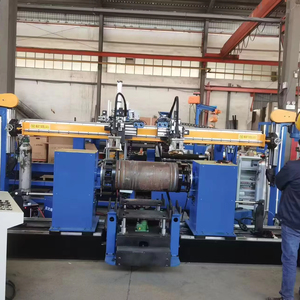
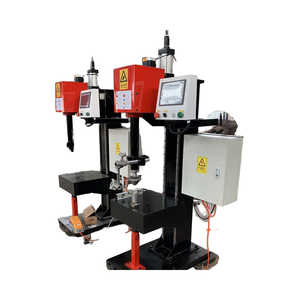
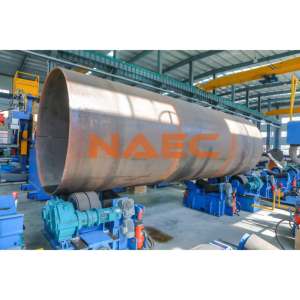
Explore our engineered industrial rotary welding systems designed for cylindrical vessels, pressure tanks, pipelines, and drum bodies.
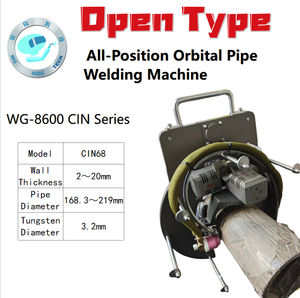
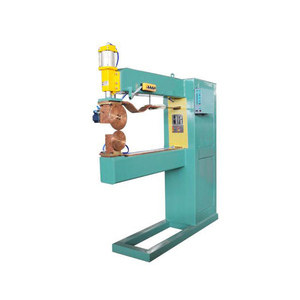
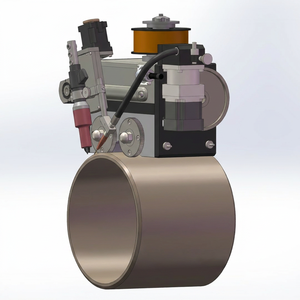
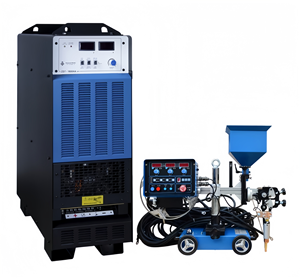
Understanding the physics, mechanical kinematics, and digital control loops involved in achieving 100% volumetric non-destructive testing (NDT) compliance in rotational vessel jointing.
Circumferential seam welding (also known as circular or girth welding) represents one of the most critical manufacturing processes in heavy engineering, boiler fabrication, storage tank production, and pressure vessel construction. Unlike longitudinal seam welding where the welding head traverses over a linear planar joint, circumferential seam welding requires absolute synchronization between workpiece rotation and wire feeder control or torch oscillation.
As a premiere China Best Circumferential Seam Welder Manufacturer & Exporter, our engineering philosophy revolves around eliminating thermal distortion, mitigating melt-through (burn-through), and ensuring flawless bead geometry. Modern industrial requirements under ASME Section VIII, ISO 3834-2, and EN 1090 mandate zero internal defects such as porosity, lack of side-wall fusion, or tungsten inclusions. Achieving these standards consistently requires advanced closed-loop inverter technology combined with high-precision mechanical motion equipment.
Whether handling thin-walled stainless steel food-grade drums (0.8 mm thickness using DC TIG/GTAW) or thick-walled petrochemical pressure vessels (exceeding 50 mm carbon steel using Submerged Arc Welding / SAW), selecting the optimal machine kinematics—vertical rotary vs. horizontal shell turning rolls—determines plant throughput and unit manufacturing cost.
Engineered comparison of TIG, MIG/MAG, and SAW integration for circumferential joining systems.
| Technical Parameter | Gas Tungsten Arc (GTAW / TIG) | Gas Metal Arc (GMAW / MIG-FCAW) | Submerged Arc (SAW) |
|---|---|---|---|
| Target Wall Thickness | 0.8 mm – 6.0 mm | 3.0 mm – 20.0 mm | 12.0 mm – 100+ mm |
| Deposition Rate (kg/hr) | 0.8 – 2.2 kg/h | 3.5 – 8.0 kg/h | 8.5 – 24.0 kg/h |
| NDT X-Ray Pass Rate | 99.8% (Highest Purity) | 98.5% (Requires Clean Gas Shield) | 99.5% (Deep Penetration) |
| Heat Input Control | Extremely Precise (Low HAZ) | Moderate (Risk of Spatter) | High Thermal Mass (Deep Fusion) |
| Seam Tracking Mechanism | Arc Voltage Control (AVC) / High-Freq Laser | Touch Sensing & Tactile Sensor | Laser Vision & Heavy-Duty Cross Slide |
| Primary Industrial Use | Pharma Tanks, Cryogenic Cylinders, Exhaust Pipes | LPG Bottles, Air Compressors, Automotive Axles | Boiler Drums, Wind Towers, Heavy Pressure Vessels |
Over two decades of in-house design, component-level manufacturing, and turnkey system integration.
We do not assemble third-party modules. Our engineers design power circuit boards, IGBT driver cards, and DSP digital controllers in-house, ensuring 100% hardware-software synergy.
Every circumferential seam welder undergoes 72 hours of continuous load testing under maximum thermal stress before export, ensuring full alignment with international safety standards.
Integrated real-time vision sensors track workpiece runout, ovality tolerances, and joint variation dynamically adjusting torch position within ±0.05mm accuracy.
From 50 kg pneumatic tailstock lathe bed rotators to 100-ton self-aligning turning rolls, we provide unified single-source mechanical automation compatibility.
Monitor real-time arc-on time, voltage drift, wire feed rate, and energy consumption per joint via cloud dashboards for total quality traceability.
Comprehensive spare parts backing, custom input voltage configuring (220V/380V/415V/480V at 50/60Hz), and remote commissioning by senior welding engineers.
How artificial intelligence, digital twin modeling, and advanced power electronics are redefining vessel production.
Traditional tactile memory probes are being superseded by 3D structured-light vision cameras. These sensors map the groove geometry in real time, automatically calculating multi-pass layer placement and heat input adjustments for varying root gaps.
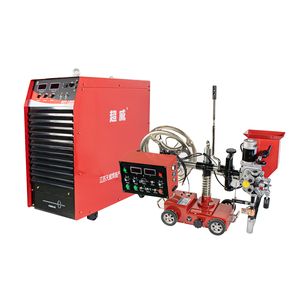
The transition from conventional 50Hz transformer systems to 100kHz IGBT inverter topologies reduces line power consumption by up to 35%, while providing microsecond arc responsiveness to prevent melt-through on thin metal shells.
To achieve unmatched deposition rates on thick pressure vessels, modern circumferential stations combine hot-wire TIG root pass welding with twin-wire submerged arc (SAW) cap passes on a single automated gantry platform.
Key criteria international sourcing directors evaluate when choosing a Chinese welding equipment exporter.
Global procurement teams no longer select machinery based solely on upfront purchase price. Factoring in arc-on efficiency, power factor correction (>0.95), consumable longevity, and downtime risk has shifted preferences toward heavily engineered, certified Chinese manufacturing plants capable of providing high uptime guarantees.
Fabricators demand flexible work cells. A single circumferential lathe turning bed should be capable of rapidly swapping between GMAW (MIG), GTAW (TIG), and SAW torch heads depending on production batch schedules. Modular mounting interfaces are now mandatory in RFQs.
For pressure vessel production subjected to ASME stamp audits, procurement specs now require digital parameter logging. Sourcing managers explicitly request Ethernet/Modbus communication ports to integrate welding machines directly with plant MES (Manufacturing Execution Systems).
Direct technical insights to guide your equipment specification and purchasing process.
Horizontal circumferential seam welders position the workpiece cylindrical axis horizontally, supported by turning rolls or spindle headstocks. This arrangement is ideal for long pipes, large storage tanks, and heavy pressure vessels. Vertical circumferential welders hold the tank shell vertically, using a rotating turntable. Vertical orientation prevents gravity-induced liquid weld pool sagging on thin-walled tanks (e.g., milk/beer storage vessels) and reduces shop floor footprint.
Workpiece out-of-roundness, mechanical thermal expansion, and fit-up misalignment create variations in joint position during rotation. Laser seam tracking projects a light ribbon across the joint, capturing 3D profile geometry hundreds of times per second. The controller automatically corrects the X-Y cross slide and torch height (AVC), keeping the electrode perfectly positioned inside the groove root regardless of vessel ovality.
Yes. By switching the power source process mode (e.g., from DC Pulse TIG for stainless steel to Submerged Arc or MIG for carbon steel) and using dedicated non-contaminating drive rollers (polyurethane or stainless contact points), the mechanical lathe structure can process multiple metal grades seamlessly.
Our heavy-duty industrial power units can be custom-built to support 3-Phase 220V, 380V, 415V, 440V, or 480V input power at either 50 Hz or 60 Hz. Built-in digital line voltage compensation protects internal electronics against grid voltage fluctuations of ±15%.
Radiographic quality welds depend on precise arc length control, uniform travel speed, and clean gas shielding. Our integrated system pairs micro-stepping motor positioners with dynamic arc voltage feedback (AVC), maintaining constant heat input per millimeter to eliminate lack of penetration and internal porosity.
Standard automated circumferential seam welding machines are manufactured within 25 to 35 business days. Custom heavy-duty gantries take 45 days. All equipment is vacuum-sealed with anti-rust desiccant and packed in export-certified IPPC wooden cases for oceanic container transport.
We provide remote video-assisted setup, PLC online diagnostics, complete electrical schematic documentation, and fast-dispatch spare part kits (including torches, ceramic nozzles, wire feed rolls, and tracking sensors) shipped via DHL/FedEx worldwide.
Consult with our senior welding application engineers to receive customized machine drawings, weld procedure specifications (WPS), and direct factory quotes.