
Select from our CE-compliant equipment catalog for structural, pipeline, sheet metal, and automated joining applications.
As a global pioneer in industrial power sources and automated fabrication machinery, our engineering design framework centers on delivering CE Certified Stud Welding Machine systems that solve complex fastening challenges across severe-duty sectors. Stud welding represents an ultra-fast, high-integrity joint creation methodology where metallic studs or threaded fasteners are fused to a parent metal substrate without requiring hole drilling, tapping, or double-sided access.
Modern production environments—spanning naval shipbuilding, bridge construction, high-speed rail assembly, and nuclear containment vessels—demand absolute metallurgical reliability. Substandard fasteners or inconsistent arc timing can cause catastrophic mechanical shear failures under fatigue loading. As an ISO 9001:2015 certified manufacturer operating a vertically integrated R&D facility in Gujarat, India (Advanced Power Sources Ltd / APS Welding ecosystem), we manufacture IGBT inverter-based drawn arc stud welders and capacitor discharge (CD) systems engineered to fulfill rigorous European Conformity (CE) directives including 2014/35/EU (Low Voltage), 2014/30/EU (EMC), and EN ISO 14555 stud welding specifications.
Unlike traditional Shielded Metal Arc (SMAW) or Gas Metal Arc (GMAW) tack welding of studs—which causes extensive Heat-Affected Zones (HAZ), plate burn-through, and micro-cracking—CE-certified stud welding operates via controlled electrical discharge lasting between 1 millisecond and 1000 milliseconds. The resultant joint develops a full-cross-sectional weld area where the bond strength exceeds that of the stud material itself.
Determining the ideal stud welding architecture requires evaluating parent material thickness, fastener diameter, surface coating, and mechanical shear strength criteria. Enterprise procurement teams must evaluate three dominant technological pathways:
Arc Duration: 1 to 3 milliseconds
Stud Range: M3 to M10 (Ø 2mm to 10mm)
Ideal Substrates: Thin sheet metals (≥ 0.5mm), gauge steel, stainless steel, aluminum, brass.
Operational Mechanism: Uses a capacitor bank charged to a precise DC voltage. A small ignition tip at the base of the stud vaporizes instantaneously upon contact, striking an intense arc that melts the stud flange and substrate surface before spring force forces the stud into the molten pool. Zero rear-side marking makes it perfect for cosmetic enclosures, HVAC, and electronics cabinets.
Arc Duration: 100 to 1000 milliseconds
Stud Range: M6 to M25 (Ø 6mm to 25mm)
Ideal Substrates: Heavy structural steel plate, composite beams, pressure vessels, shipbuilding hulls.
Operational Mechanism: Powered by heavy-duty Constant Current (CC) IGBT inverter power sources. The stud gun lifts the stud off the work plate while initiating a pilot arc, followed by a main melting arc. A ceramic ferrule surrounds the weld zone to contain molten metal and shape a protective collar. Delivers extreme tensile and torsional shear resistance under dynamic structural load.
Arc Duration: 10 to 100 milliseconds
Stud Range: M3 to M12 (Ø 3mm to 12mm)
Ideal Substrates: Automotive body shell panels, chassis fabrication, galvanized sheet metal.
Operational Mechanism: Bridges the gap between CD and Drawn Arc. SC operates without ceramic ferrules (often utilizing shielding gas like Ar/CO2) on medium-gauge sheet metals where light oil or galvanized coatings are present. Highly adaptable to robotic automated production lines.
| Performance Parameter | Capacitor Discharge (CD) | Short Cycle (SC) | Drawn Arc (DA) Standard | Heavy-Duty Inverter DA |
|---|---|---|---|---|
| Target Fastener Range | M3 – M10 (Threaded / Flanged) | M3 – M12 (Plain / Threaded) | M6 – M16 (Shear Connectors) | M12 – M25 (Heading Studs) |
| Power Source Tech | Capacitor Storage (100,000μF+) | Microprocessor IGBT Inverter | Transformer / Thyristor Rectifier | Advanced Digital Inverter (CC/CV) |
| Minimum Base Thickness | 0.5 mm (No heat marks) | 1.5 mm | 3.0 mm | 6.0 mm+ |
| Weld Shielding Requirement | None required | Shielding Gas (Ar/CO2 optional) | Ceramic Ferrule (KSR type) | High-Temp Ceramic Ferrule |
| CE EMC Compliance Level | Class A Industrial (EN 60974-10) | Class A Industrial | Class A Industrial | Class A Heavy Industrial |
| Duty Cycle Rating (IEC 60974-1) | 20 studs/min (Continuous) | 40 studs/min (Robotic Line) | 10 studs/min at Max Amperage | 100% Continuous at nominal current |
When sourcing industrial stud welding equipment globally, procurement leaders face significant risks related to substandard electrical component sourcing, fake CE declarations, and inadequate after-sales technical support. Our manufacturing footprint (Advanced Power Sources Ltd / APS Welding) addresses these buyer friction points through vertically integrated engineering control:
We do not assemble off-the-shelf white-label kits. Our specialized electronics team designs every main inverter power board, pulse control loop, and trigger logic card in-house. Circuit boards undergo conformal coating to withstand humid, dusty, and abrasive shipyard environments.
Our stud welding machines feature wide input voltage tolerance (±15%), enabling seamless operation on unstable site generators across Asia, the Middle East, Africa, Europe, and the Americas (380V/415V/440V 3-Phase 50/60Hz configurations).
Every single stud welding power unit undergoes full thermal cycle load-bank testing at 40°C ambient temperature in accordance with IEC 60974-1 standards prior to export packaging, eliminating out-of-the-box field failure rates.
As global fabrication shifts toward Industry 4.0 digitisation, lightweight alloy structures, and carbon-footprint reduction, procurement managers must future-proof their machinery investments. Key technological trajectories shaping the market include:
High-volume automotive EV assembly and sheet metal enclosure lines are rapidly moving away from manual hand-guns. Modern drawn arc and CD stud welders now feature high-speed digital I/O interfaces, EtherCAT/PROFINET communication protocols, and automatic stud feeding systems capable of placing up to 60 studs per minute with ±0.1mm positional accuracy when integrated with CNC positioners or multi-axis robotic arms.
Quality assurance standards in nuclear, aerospace, and bridge fabrication require complete traceability of every single fastener. Emerging Industry 4.0 stud welders log real-time parameters—including peak current, arc voltage, lift height, plunge speed, and arc duration. Systems like our WeldVisor IoT module trigger automated visual/audible alerts if a weld parameter deviates from the qualified Welding Procedure Specification (WPS).
Field erection teams working on structural steel elevated decks or remote insulation projects require lightweight, high-energy-density power units. Hybrid battery-capacitor stud welders allow operators to execute hundreds of M3 to M8 CD stud welds without continuous mains power hookups.
Technical and commercial clarity for procurement managers, structural engineers, and international distributors.
CE certification confirms that the stud welding machine complies with mandatory European Union safety, health, and environmental protection requirements. Specifically, industrial stud welders must adhere to EN 60974-1 (Safety Requirements for Arc Welding Power Sources) and EN 60974-10 (Electromagnetic Compatibility - EMC standards). This ensures the machine does not emit harmful electromagnetic interference that could disrupt surrounding CNC lasers, automated robotics, or control circuits, and protects operators against electrical shock and thermal hazards.
Selection depends primarily on substrate thickness and required stud diameter:
Yes, Capacitor Discharge (CD) stud welding power sources can weld mild steel, stainless steel, aluminum alloy, and brass studs onto similar base metals. However, when welding aluminum studs, a special contact or gap-mode stud gun with precise spring pressure and shielding gas integration (Argon) is recommended to prevent rapid oxide layer formation during the micro-arc phase.
The duty cycle (rated to IEC 60974-1 at 40°C ambient temperature) indicates the percentage of a 10-minute period that the machine can operate continuously at a specified current before overheating. For example, a 60% duty cycle at 1200A means the machine can weld for 6 minutes continuously at 1200A, followed by 4 minutes of cooling. Premium industrial machines utilize high-efficiency IGBT inverters and forced air cooling to maintain high duty cycle output during continuous shift work.
Ceramic ferrules serve three vital functions in drawn arc stud welding: (1) They contain the molten metal pool created by the high-current arc, forming a consistent fillet ring around the base of the stud; (2) They shield the molten weld pool from atmospheric contamination (oxygen/nitrogen nitridation); and (3) They protect the operator from molten metal splash during the final plunge sequence.
To ensure optimal machine configuration, buyers should specify:
Manufacturers with in-house R&D and PCB production (such as Advanced Power Sources Ltd) maintain long-term availability of replacement power modules, control boards, and firmware updates. Buyers avoid machine obsolescence caused by third-party component sourcing changes, ensuring rapid delivery of original factory spare parts worldwide.
Achieving maximum efficiency in high-throughput structural steel or sheet metal facilities requires pairing CE-certified stud welders with compatible material handling and positioning equipment. Our complete manufacturing ecosystem includes:
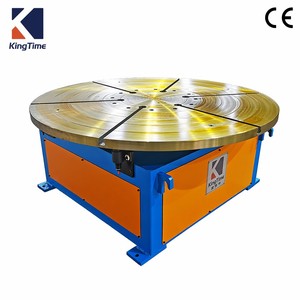
Motorized rotary tables (capacities from 50kg to 10,000kg) allow heavy pipes, cylindrical vessels, and structural flanges to be angled for ergonomically optimal flat-position stud placement, maximizing weld penetration and operator safety.
High-precision plate profiling systems prepare structural steel parts, mounting plates, and gussets prior to automated stud welding cell processing, ensuring clean, scale-free attachment points.
Heavy-duty multi-process power sources deliver up to 1250A for weld defect removal, root pass back-gouging, and bevel preparation on thick plate fabrication projects before final assembly.
Request an engineering consultation, customized technical proposal, or comprehensive product catalog from our global export division today.
Get Catalog