
Choosing among the 2026 Top CNC Plasma Gantry Cutting Machine Types requires more than comparing torch speed or advertised amperage. A reliable decision begins with the workpiece. Thin sheet metal may need a compact two-axis gantry, while structural steel often demands a heavier three-axis system with automatic height control. Bevel cutting adds another layer, especially when welded edges must fit tightly.
Water-table machines reduce heat and airborne dust around the cut. Downdraft tables can suit facilities with limited water-handling capacity. Some workshops need pipe attachments, drilling heads, or oxy-fuel stations beside the plasma torch. Others gain more from a simple, rigid frame than from excessive automation. Small details matter, including cable routing, nozzle access, torch collision protection, and controller support.
Manufacturing educator John A. McGeough has stressed a practical principle: “Process control matters more than speed alone.” That idea remains useful when evaluating a CNC Plasma Gantry Cutting Machine. A faster torch can still produce poor parts if the plate vibrates or the arc height fluctuates. I have seen specifications look impressive on paper, yet maintenance access was awkward and consumable costs were underestimated. That is an uncomfortable lesson.
This guide compares leading machine types by cutting thickness, table design, automation, accuracy, operating cost, and workshop fit. It also considers less visible factors, such as operator training and service response. The “best” machine is not universal. It depends on material, production volume, tolerances, floor space, and the quality standards your customers actually enforce.
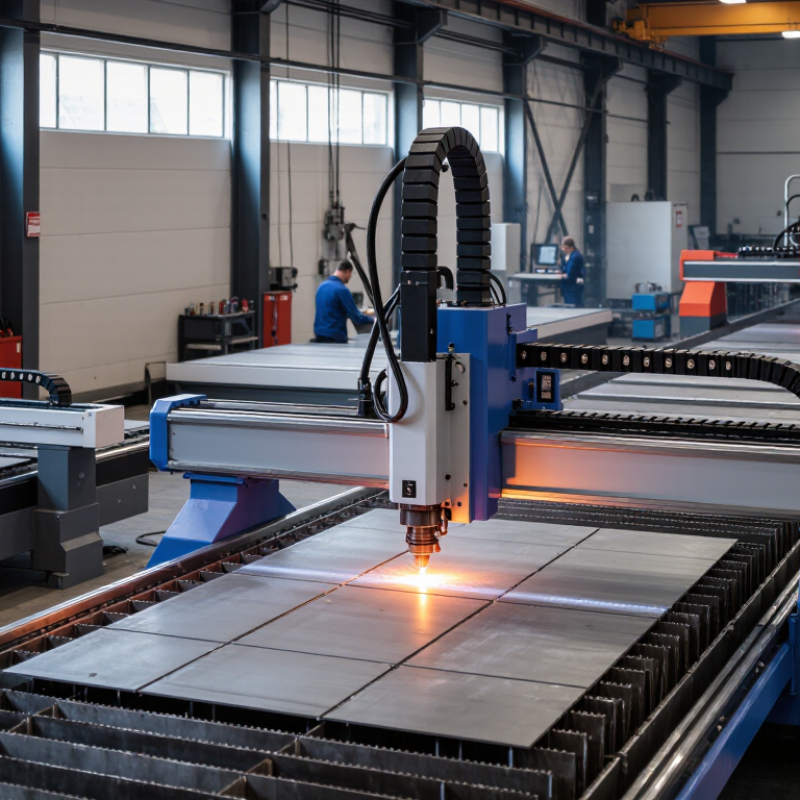
Gantry plasma CNC machines are best classified by usable cutting capacity, not amperage alone. The 40–400 A range covers very different production needs. A 40–80 A system suits thin sheet, signage work, and light fabrication. It can deliver clean edges on mild steel when the table remains level. Small consumables can also reduce operating costs. That matters. However, its piercing depth remains limited.
Systems from 100–160 A occupy the practical middle. They handle medium plate, repeated brackets, and structural parts with steadier productivity. Operators should compare rated piercing thickness with recommended production thickness. The difference can be substantial. A 130 A source may pierce 25 mm, yet cut 16 mm efficiently throughout a shift. In practical operation, airflow, torch height control, and grounding often affect results more than a higher current setting. A rough edge is rarely solved by amperage alone.
Heavy-duty 200–400 A gantries target thick plate, bevel preparation, and demanding fabrication schedules. Wider rails and stronger drive systems help manage long cuts and heavy workpieces. These machines need suitable extraction, cooling, power supply, and maintenance access. Otherwise, capacity exists only on paper. High current can increase kerf width, dross, and consumable wear when settings are poorly matched. I would specify material grade, thickness range, daily hours, and required edge quality before choosing a class. My earlier mistake was judging a machine by maximum amperage. Real output depends on the complete process.
A practical classification of gantry-style CNC plasma systems by nominal plasma current, typical mild-steel cutting range, machine format, and suitable production use.
| System Type | Nominal Plasma Current | Typical Mild-Steel Piercing Range | Typical Production Cutting Range | Maximum Cut Capability* | Common Table Size | Gantry and Drive Configuration | Best-Fit Materials and Jobs | Recommended Operating Profile |
|---|---|---|---|---|---|---|---|---|
| Compact Light-Duty Gantry CNC | 40–60 A | Up to approximately 10–12 mm | 3–12 mm | Approximately 16–20 mm with suitable consumables and controlled speed | 1,500 × 3,000 mm; smaller custom beds are common | Light steel gantry; rack-and-pinion or belt drive; single or dual-side synchronization | Thin sheet, brackets, signs, ductwork, repair parts, agricultural components | Low-to-medium duty cycle; prioritizes low operating cost, compact footprint, and fast setup |
| General-Purpose Medium Gantry CNC | 80–100 A | Approximately 16–20 mm | 6–20 mm | Approximately 25 mm, depending on material grade, speed, and consumable condition | 1,500 × 3,000 mm or 2,000 × 4,000 mm | Rigid welded gantry; dual-drive longitudinal axis; rack-and-pinion transmission | Machine frames, structural brackets, general fabrication, light construction parts | Suitable for mixed-job workshops requiring a balance of speed, edge quality, and flexibility |
| High-Definition Medium Gantry CNC | 100–130 A | Approximately 20–25 mm | 8–25 mm | Approximately 30 mm under controlled production conditions | 2,000 × 4,000 mm or 2,000 × 6,000 mm | Heavy welded or stress-relieved gantry; precision linear guidance; automatic torch-height control | Flanges, enclosures, machinery parts, structural steel components, repeat production work | Good choice where tighter hole quality, repeatability, and improved bevel control are important |
| Heavy-Duty Production Gantry CNC | 160–200 A | Approximately 25–32 mm | 10–32 mm | Approximately 40–50 mm, subject to the power source and process parameters | 2,000 × 6,000 mm; 2,500 × 6,000 mm is also common | Reinforced dual-drive gantry; steel rails; industrial torch-height control; optional drilling or oxy-fuel stations | Heavy fabrication, structural members, trailer parts, frames, industrial equipment components | Designed for higher throughput, longer production runs, and thicker mild-steel plate |
| Heavy Plate Gantry CNC | 250–300 A | Approximately 32–40 mm | 12–40 mm | Approximately 50–60 mm in suitable heavy-plate applications | 2,500 × 6,000 mm or 3,000 × 12,000 mm | Extra-rigid gantry; heavy rails and support structure; automatic torch-height and arc-voltage control | Heavy structural steel, bridge and building components, large bases, industrial skids | Best for high material utilization and sustained cutting of thick plate; requires strong fume and slag management |
| Ultra-Heavy Plate Gantry CNC | 350–400 A | Approximately 40–50 mm | 16–50 mm | Approximately 60–80 mm in specialized production conditions; performance varies substantially by process | 3,000 × 12,000 mm or larger custom-format beds | Very heavy welded gantry; dual-side synchronized drives; reinforced rails; advanced height sensing and plate alignment | Shipbuilding, large structural assemblies, mining equipment, pressure-vessel components, thick industrial plate | For high-capacity plate processing; slower piercing, higher consumable usage, and greater power and ventilation requirements |
Classify it by usable cutting capacity, not amperage alone. A 40–80 A system suits thin sheet and light fabrication. A 100–160 A system handles medium plate and repeated structural parts. A 200–400 A system targets thick plate and bevel preparation. Maximum amperage can mislead.
This range suits thin mild steel, signs, brackets, and light workshop parts. A level table helps maintain clean edges. Smaller consumables may lower operating costs. Piercing depth remains limited. Do not expect heavy-plate performance.
A 130 A source might pierce 25 mm but cut 16 mm efficiently all day. Piercing starts the cut; production cutting must remain stable. Travel speed, heat, airflow, and edge quality affect the result. The numbers are not interchangeable.
No. Higher current can widen the kerf and increase slag. Poorly matched settings may also wear consumables faster. Torch height, grounding, and airflow often matter more. I once judged capacity by amperage alone. That was incomplete.
Multi-torch systems suit high-volume plate cutting. Two to six torches can follow separate programmed paths. Several parts may be cut during one cycle. This reduces idle travel. More torches are not always better.
Shared cutting zones create additional heat. Thin plate may distort near nearby cuts. Torch spacing, nesting, gas delivery, and height sensing need careful control. Operators should inspect consumables after each shift. Coordination can become difficult.
A tilting head can create V, Y, and K-style edges up to 45 degrees. This may reduce grinding before welding. The programmed angle still requires verification. Measure the actual bevel with a gauge. A drawing is not proof.
Test real material, real thicknesses, and actual nesting files. Check pierce time, cut-face quality, bevel accuracy, and slag. Record consumable wear after repeated cuts. Confirm extraction, cooling, power, and maintenance access. The machine rating is only a starting point.
The 2026 CNC Plasma Gantry Cutting Machine market can be classified by cutting capacity, torch configuration, and edge-processing capability. Air-plasma gantries typically use 40–105 A systems and are suitable for efficient cutting of mild steel up to approximately 25 mm. They offer a practical solution for general fabrication, repair work, and routine plate processing where speed and operating simplicity are priorities.
For higher precision and productivity, high-definition plasma gantries range from 100–400 A and can support defined ISO 9013 cut-quality classes. Multi-torch gantries, equipped with two to six torches, are designed for high-throughput production and repeated plate cutting. Bevel and hybrid gantries add advanced cutting flexibility, producing edges up to 45° and processing plates exceeding 50 mm, depending on the system configuration. Together, these categories help users select equipment according to material thickness, required accuracy, production volume, and edge geometry.
