
Choosing a Multi Operator Welding Power Source in 2026 requires more than comparing amperage figures. Real fabrication floors are noisy, demanding, and rarely predictable. Several welders may work simultaneously on structural steel, pressure components, or repair assemblies. Each station needs stable output, dependable arc performance, and clear operator control.
James F. Lincoln, a pioneer in welding technology, offered a practical reminder: “The quality of a weld depends on the skill of the welder.” That principle still matters. A powerful machine cannot correct poor preparation, incorrect polarity, or careless parameter selection. However, the right system can reduce interruptions and support consistent workmanship across multiple operators.
This guide examines the details that influence daily performance. These include duty cycle, total output, process compatibility, feeder integration, voltage regulation, and thermal protection. It also considers cable length, grounding quality, ventilation, service access, and power distribution. Small details become expensive problems when several arcs run together.
No power source is perfect. That deserves attention. A high-output unit may demand more space, maintenance, and electrical capacity. A compact system may simplify installation but limit simultaneous welding. Buyers should compare actual production needs rather than brochure ratings. Field experience, manufacturer documentation, and verified service support should guide the final decision. This 2026 guide helps contractors, plant managers, and welding professionals evaluate those trade-offs with greater confidence, while leaving room for one honest conclusion: the best system depends on the work it must repeatedly survive.
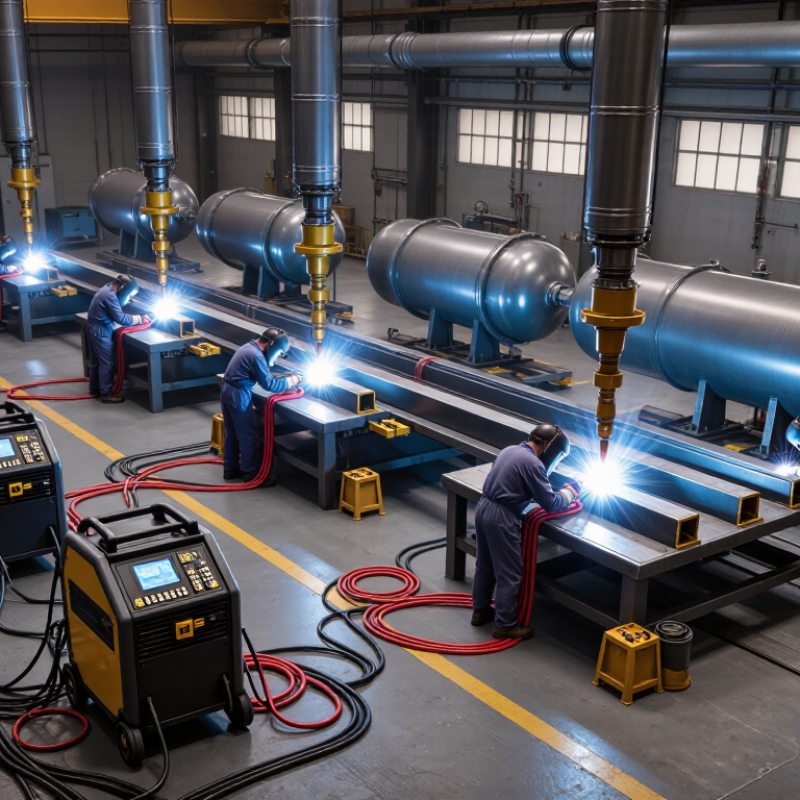
A multi-operator welding power source supplies welding energy to several operators from one central unit. Instead of placing a separate machine beside every workbench, the system sends controlled power through feeder cables and remote stations. Each welder can adjust essential settings, such as output current and arc characteristics, at the work area. This arrangement suits fabrication shops, shipyards, structural projects, and training facilities with many active welding points.
The main advantage is organized power management. A properly selected unit can reduce floor congestion, simplify maintenance, and support steady production. However, capacity must match real demand. Simultaneous welding, cable length, duty cycle, and electrode type all affect performance. Field experience shows that undersizing the system creates voltage drop, unstable arcs, and frustrated operators. That is easy to overlook. Ventilation, grounding, cable protection, and routine inspections also require disciplined attention. One missed connection can interrupt several workstations.
Tips: Count the maximum number of welders working at once, not the total number assigned. Check each operator’s process and amperage range before choosing capacity. Keep cables dry, protected from vehicle routes, and clearly labeled. Test remote controls during setup. It is also wise to record load readings during a busy shift, because actual usage may differ from planning estimates. Review the layout after installation; a technically correct system can still waste time if operators must stretch cables or share poorly placed controls.
Multi-operator welding systems allow several welders to work from one centralized power source. The main unit distributes electrical power through separate feeder cables or remote stations. Each operator controls welding current and voltage at the work area. This reduces equipment clutter and keeps adjustments close to the joint.
Inside the system, power management balances demand between operators. Digital controls monitor output, duty cycle, temperature, and fault conditions. If one welder increases amperage, the controller must protect stable output for the others. Proper cable sizing matters, especially across long distances. Poor connections can create heat, voltage drops, or an uneven arc. A practical workshop check includes inspecting plugs, grounding points, cooling airflow, and display readings before production begins. The setup is efficient, but it is not magic. A shared source can become a bottleneck when every operator works at maximum output. That limitation deserves honest planning.
Tips: Calculate simultaneous amperage, not just the total number of welders. Keep feeder cables short and protected from sharp edges. Mark each remote station clearly. Test the system under realistic load conditions. Record temperature and fault readings during the first shift. Small details matter.
Selecting a 2026 welding power source starts with the real workload, not the highest advertised amperage. For multi-operator use, check total output, duty cycle, and input capacity together. A unit rated for 500 amps may deliver less under continuous production heat.
Heat matters. Review its duty-cycle test conditions and ambient temperature.
Confirm how many operators can weld simultaneously at practical settings. The source should maintain stable arcs during changing loads, especially when several welders share one system. Check process support for MIG, TIG, stick, and flux-cored work. Adjustable inductance, arc force, and waveform control can improve starts, penetration, and spatter. Digital monitoring is useful when it records current, voltage, operating hours, and fault history. Ask for proof.
Cooling design deserves close attention. Inspect fan control, air pathways, cable connections, and overload protection.
Dusty fabrication areas can expose weak designs quickly. Select suitable input voltage and phase options for the available workshop supply. Oversized input requirements may increase installation costs and cause nuisance trips.
A practical comparison should include output accuracy, interface clarity, remote-control compatibility, and service access. Operators often lose time navigating complicated menus. That detail is easy to underestimate. Request independent test data, applicable safety certifications, and clear maintenance intervals. Also examine the warranty terms and local technical support. Specifications can look perfect on paper, yet poor cable routing or awkward controls may frustrate the team every shift. Recheck those details before purchase.
A 2026 multi-operator welding power source should be judged by usable capacity, not its maximum amperage. A high-output unit may support several arcs, but shared power can reduce stability during simultaneous starts. Check rated duty cycle, voltage tolerance, arc efficiency, and output at the intended load. The Manufacturing Institute and Deloitte estimate that 3.8 million manufacturing jobs may be needed in the United States between 2024 and 2033, with 1.9 million potentially unfilled. That pressure makes productive equipment important.
Capacity is not everything. A fabrication shop may need constant-current output for stick welding, controlled voltage for wire processes, and precise low-amperage control for thin materials. Process flexibility reduces equipment changes, but it can also increase setup errors. Clear digital settings, isolated feeder controls, and visible fault codes help operators work beside noisy welding bays. I would not assume more process modes always mean better performance.
Operator support deserves equal attention. The American Welding Society has projected approximately 330,000 welding job openings in the United States through 2028. Training time matters. Look for remote diagnostics, simple parameter libraries, accessible manuals, and service records that technicians can understand quickly. A practical trial should measure arc stability, cable heat, restart behavior, and operator adjustment time. One overlooked issue remains training consistency. Even strong equipment performs poorly when every operator uses a different setup.
In 2026, selecting a multi-operator welding power source starts with the workplace, not the catalog. A unit must match input voltage, phase, duty cycle, and expected simultaneous output. Installation should be planned by qualified electrical personnel. They verify breaker capacity, cable sizing, grounding, ventilation, and clear access before energizing the equipment. Keep leads short where practical, and protect them from forklifts, sharp edges, and standing water. A clean installation reduces voltage drop and unexpected shutdowns.
Safety depends on daily behavior, not warning labels alone. Operators need suitable helmets, gloves, flame-resistant clothing, hearing protection, and dry footwear. Local exhaust ventilation should capture fumes near the arc without disturbing shielding gas. Inspect electrode holders, return clamps, connectors, and insulation before every shift. Use hot-work controls when nearby materials can ignite. I have seen teams overlook the return clamp. That small mistake can create heat at an unintended connection. Training should cover shared output limits and emergency isolation. Never assume a quiet machine is electrically safe.
Maintenance is more than removing dust. Record load hours, fault codes, inspections, and repairs in a simple log. Clean cooling passages with approved methods, then check fans and terminals for heat damage. Calibration checks matter when weld quality affects structural reliability. In fabrication shops, multiple operators can work on frames without waiting for one power source. Repair crews also benefit when space and generator capacity are limited. Still, shared capacity can encourage overloading during production pressure. My earlier assumption was that higher capacity solved every delay. It did not. Supervisors should compare actual arc time with rated duty cycles and adjust work sequencing.
Typical output-current planning ranges for common welding processes. Actual settings depend on electrode or wire size, material thickness, joint design, shielding gas, and the power source duty cycle.
For installation, size the electrical supply and ventilation for the equipment nameplate ratings. For safe operation, use the correct PPE, grounding, cable connections, and work-area controls. During maintenance, inspect leads, connectors, cooling paths, and ventilation regularly, and isolate power before servicing. Multi-operator systems should be selected according to simultaneous load, workplace layout, process mix, and required duty cycle.
Start with actual workload, not the highest advertised amperage. Check duty cycle, input capacity, and simultaneous operator demand. Heat changes performance.
Test several arcs starting together. Watch arc stability, cable heat, restart behavior, and output accuracy. Shared power may reduce stability.
Consider MIG, TIG, stick, and flux-cored work. Constant-current output suits stick welding. Controlled voltage supports wire processes.
Not necessarily. Extra modes can increase setup mistakes. Clear screens, visible fault codes, and isolated controls help operators work consistently.
Check fan control, air pathways, overload protection, and cable connections. Dusty areas expose weak cooling designs quickly. Clean passages regularly.
Confirm input voltage, phase options, breaker capacity, cable sizing, and grounding. Qualified electrical personnel should verify the installation. Avoid oversized input requirements.
Inspect holders, return clamps, connectors, and insulation. Wear suitable helmets, gloves, protective clothing, hearing protection, and dry footwear. Check the return clamp.
Record load hours, fault codes, inspections, repairs, and calibration checks. These details help technicians find repeated problems. A simple log works.
Request independent test data, safety certifications, warranty terms, and local technical support. Review menus, cable routing, service access, and remote-control compatibility. Paper specifications can mislead.
No. Overloading can still occur during production pressure. Compare actual arc time with rated duty cycles, then adjust work sequencing. My earlier assumption was wrong.
This guide explains what a Multi Operator Welding Power Source is and how it enables several welders to work from one coordinated power system. It covers the basic operating principles, including shared power distribution, independent output control, and support for different welding processes. Readers will learn how to evaluate essential 2026 specifications such as rated output, duty cycle, voltage range, number of operator connections, process compatibility, control flexibility, and energy efficiency.
The guide also compares power capacity and operator support to help teams select equipment suited to fabrication, construction, repair, and other demanding workplaces. In addition, it outlines practical considerations for installation, grounding, ventilation, cable management, workplace safety, routine inspection, preventive maintenance, and troubleshooting. By balancing performance, reliability, operator needs, and long-term operating costs, users can choose a welding power source that improves productivity while maintaining a safe, organized, and efficient work environment.